









Knowledgebase
Viewing articles tagged 'kon tum'
Viewing articles tagged 'kon tum'
19 articles
BAJARAKA, 1958
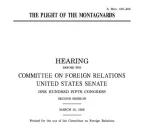
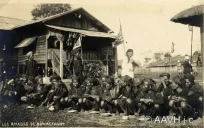
BAJARAKA is four peoples in one word: BAhnar, JArai, RAde, KAho. It was the movement in which our educated men, most of them teachers, clerks, soldiers and policemen of the new Republic of Vietnam, asked for our country back with letters, a petition and a march. They wrote to President Diem, to the American, French and British ambassadors and to...
Before history: the stone and bronze ages of the plateau
Seven thousand years ago people were living in the lava caves at Krong No, burying their dead in a flexed position, cooking at hearths and wearing ornaments made from sea-snail shells carried a hundred kilometers from the coast. That is the best-dated thing we have. Out at the edges the claims get bigger and the ground gets softer: stone tools a...
The first outsiders: Cham, Annam and the missions
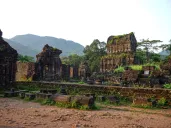
Three powers came to the edge of the highlands before the French, and each left something with us. The Cham held the coast for a thousand years, traded up our rivers, built one tower in our forest, and when their kingdom died gave their crowns into our keeping. The Vietnamese destroyed the Cham, inherited the shore, set up markets at the foot of...
A map of the highlands
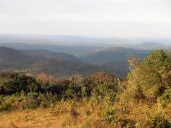
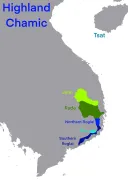
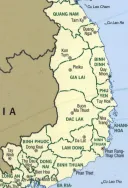
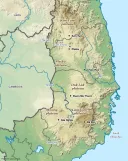
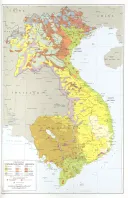
Our country is the high plateau between the Annamite mountains and the Mekong, in what Vietnam now calls the Central Highlands and across the borders in Cambodia and Laos. This page gives the map, and then the country behind it: the mountains and the red basalt plateaus, the rivers that run east to the sea and west to the Mekong, the rains, wher...
February 2001: the highlands stand up
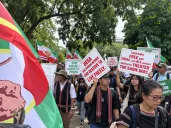
On Friday, February 2, 2001, eight hundred people from four communes walked out of their villages at four in the morning and reached Pleiku at half past eight. By mid-morning there were thousands of them outside the provincial hall. The next day the same thing happened at Buon Ma Thuot, and over the following twelve days at Ea H’leo, at Ayun Pa,...
The Kon Tum mission, 1851
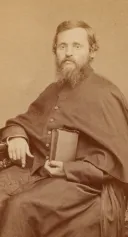
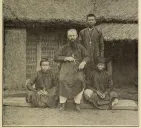
In the last weeks of 1850 a French priest of twenty-five, guided in by a Vietnamese deacon, reached the Bahnar villages of the Kon Tum basin. The mission that followed produced the first written form of any of our languages, the first dictionary, the first school, and the first outside description of who lived in the highlands and where. It is t...
The "Kingdom of the Sedang," 1888
On June 3, 1888, at the village of Kon Gung on the Poko north of Kon Tum, the chiefs of several Sedang villages signed a constitution that made a Frenchman their king. The Kingdom of the Sedang lasted about two years, issued stamps, medals and a flag, and is usually told as a comic episode in the life of an adventurer. It is worth telling from o...
The prisoner records: what they are and how to search them
Our records hold 337 Dega by name, men and one woman imprisoned for their faith, their land or their people in five provinces, arrested between 2001 and 2006. This page explains what the records are, where they came from, what they show, how they compare with the lists kept by others, what the gaps mean, and how to search them for somebody, incl...
The battles fought on our land
Both armies agreed that whoever held the Central Highlands would decide the war, so the largest battles of the American war, and the offensives that ended it, were fought where our villages stood. The histories of those battles count sorties, tons of bombs and enemy dead to the last digit. They name the hills by their height and the villages by...
Prisoners of conscience: Kontum
Eleven Dega from Kon Tum province, recorded by name as imprisoned for their faith, their land or their people, arrested in 2004 and 2005. Not one sentence is recorded against any of them. That blank column is itself the record’s clearest statement about how little news left this province. It is a record, not an argument. Every line is a person s...
The missions and the doctors
In May 1972, with Kontum under siege, the American doctor who ran the highland hospital there put half of it on helicopters and flew out. Before she went she handed the hospital over to Sister Gabriel, her most experienced Montagnard nurse. Earlier in the fighting, more than thirty of our staff and patients had lain on top of her in a human blan...
Four highland towns
The four towns of the highlands that the world knows, Buon Ma Thuot, Pleiku, Kon Tum and Da Lat, all carry highland names, and all grew up on highland land as posts of someone else’s government: a Rhade chief’s village made a French residence, a Jarai village made a militia post, a Bahnar village made a mission and then a province, and a pine-co...
Tet 1968 in the highlands
The American field force that held the highlands wrote its own verdict on Tet four pages after it counted the dead: “Heaviest attacks were launched initially” at “the highlands population centers of Kontum and Ban Me Thuot.” The first and hardest blows of the 1968 offensive in the whole of II Corps fell on two of our market towns. Then the same...
Highland refugees of the war years
In the autumn of 1970 a South Vietnamese corps commander ordered the province chiefs of the highlands to empty every one of our hamlets that had been graded C or D. Families were given a few hours’ notice, in the harvest season, and told to leave the gongs and the jars behind. At Plei De Groi, 2,500 people were moved in; by the following October...
Ha Mon: the Catholic movement the state calls an “evil way”
In a village on the Krong Poko, in the last years before the water came, a Bahnar woman named Y Gyin said that the Mother of God had appeared to her and had told her people to gather, to pray, and not to let themselves be moved. Within four years the reservoir was over the ground she named. Within eleven the state had run public denunciation mee...
The highland Catholic Church under the Socialist Republic
On March 27, 1975, in a town that had fallen eleven days earlier, the French bishop of Kon Tum consecrated a Vietnamese successor so that the diocese would not be left headless when he was expelled. Within eighteen months the minor seminary, the major seminary and the school that had trained highland catechists since 1908 were all shut, and the...
The Bahnar
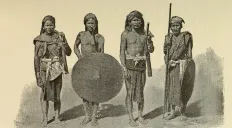
The Bahnar are the people of Kon Tum and eastern Gia Lai, with a wing that spills over the Annamite crest into the hills of Bình Định. They are the counterweight to the Rhade and the Jarai in any honest account of who we are: they speak a Mon-Khmer language, not an Austronesian one; they count descent through both parents rather than through wom...
The Sedang (Xơ Đăng)
The Sedang hold the high northern end of the plateau — the ridges above Kon Tum, the country of Dak To and Tu Mo Rong, and the shoulders of Ngoc Linh, the highest mountain in the southern Annamites. They are the people who smelted iron and sold lances and sabers to buy salt; whose language has one of the largest vowel systems ever described in a...
The smaller peoples of the highlands
Beyond the large peoples, the Rhade, Jarai, Bahnar, Sedang, Mnong, Koho and Stieng, the highlands are home to a dozen smaller ones, some of only a few tens of thousands, whose names rarely appear in the record and whom the Vietnamese state files under larger names of its own choosing. This page gathers what the sources say about each of them, so...
Powered by WBAMS